

Blocks & Breakthroughs
Why Brands Look the Same - and How to Build Meaningful Difference
An original idea gets discovered, then captured, then converted into a repeatable format. That repetition becomes the standard - and once it's the standard, it's hard to break away from, because outliers get scrutinized, or worse, ignored. The real challenge isn't originality itself. It's figuring out how to go against the grain and still be accepted and measured on equal footing with everyone else.
Why do brands, websites and marketing strategies start to look alike? In this post, we’ll explore the concept of sameness - and why calculated difference can become your competitive advantage.
Today we explore the concept of sameness as a structural outcome rather than a failure of imagination, and argue that calculated difference - deployed deliberately rather than avoided out of risk - can function as a genuine competitive advantage.
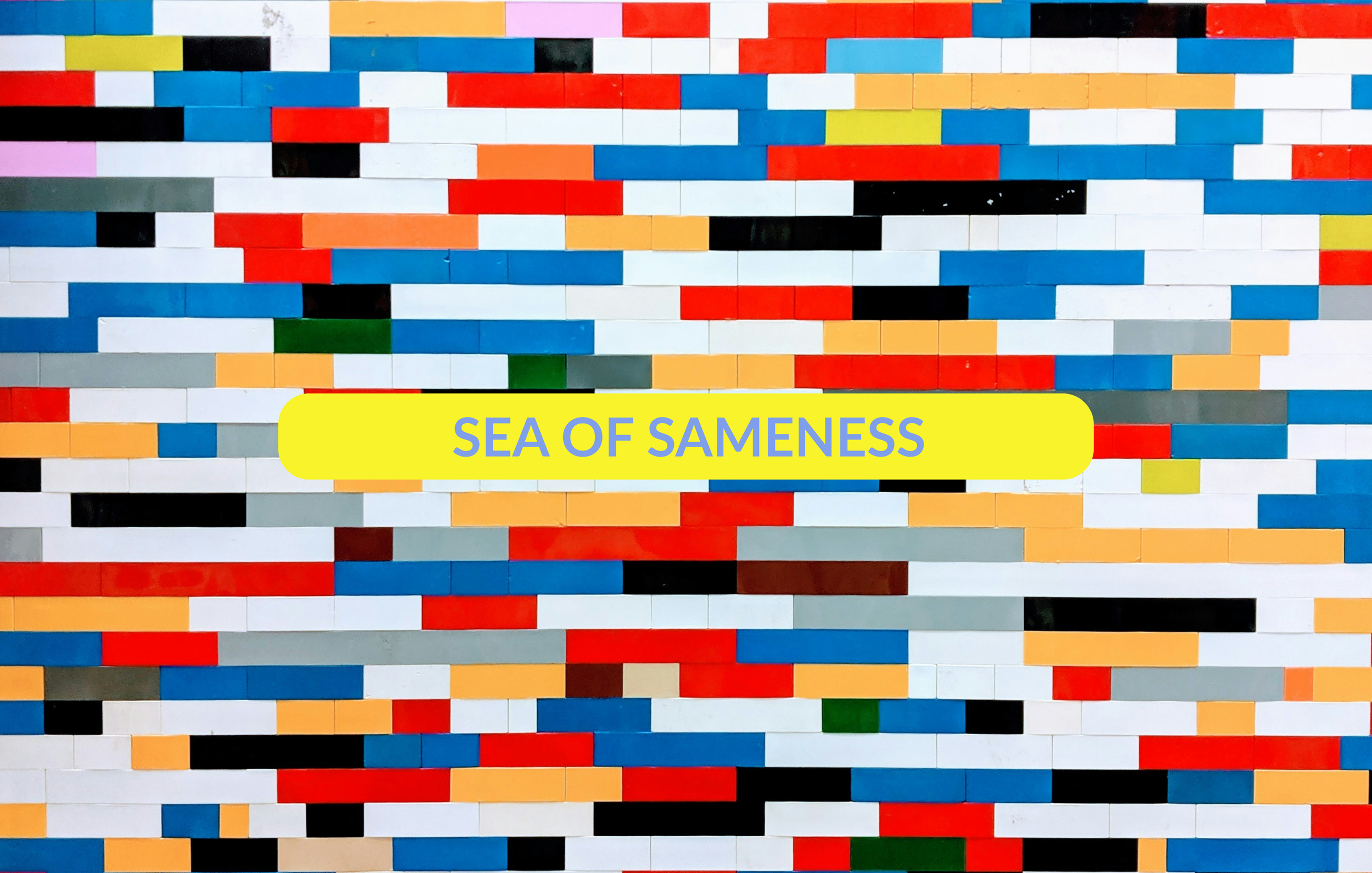
Our first graphic states: “In a sea of sameness, how do you stand apart while still staying connected?” It sounds like a branding question, but it’s actually more of a systems question. Let’s examine this idea.
Sameness comes later. Most industries begin with variation.
Someone develops an original idea. The idea works, so it gets documented. Documentation makes it repeatable. Repetition establishes a pattern. The pattern becomes recognizable. Recognition creates trust. Eventually, the pattern becomes the standard against which everything else is measured. The process looks like this:
Original idea → captured idea → repeatable format → repetition → standard
This trajectory turns an innovation into a convention. Convention simply means that something has become widely accepted. This isn’t necessarily a failure of creativity. It is often the natural consequence of successful systems. The more interesting question is what happens next:
How do you introduce something genuinely different when the system evaluating it is built around convention? How would you define connection in this situation?

We are all connected to this ‘problem’ or ‘challenge’, however you want to feel it…
Why does sameness happen?
So, let’s go back to the beginning and talk about sameness.
Sameness is often a risk-management strategy disguised as best practice. Brands converge because similarity reduces the cognitive and reputational risk of being misunderstood. Difference is expensive to explain. Sameness is comparatively cheap to understand.
A construction company looks like a construction company. A SaaS company looks like a SaaS company. A financial services website immediately signals financial services. But when buyers, executives, procurement teams, investors and algorithms come into the mix, things can quickly change. Experience becomes enrobed in intangibility – values, behaviours, interests, culture, trends, and so on. We start to categorize where we fit in. This is still sameness, but now with propensity.
Recent neuroscience research makes the underlying mechanism particularly interesting. A 2026 review in Nature Reviews Neuroscience argues that categorization isn’t simply something the brain does after perceiving information; categorization appears to operate throughout perceptual processing. Humans continuously organize what we encounter into meaningful clusters – sameness differentiated.
In other words, we don’t merely observe the world. We catalogue it. We start making similar things different intentionally. Inevitably, as a way to create more structure and organization.
This creates complexity. For example, we create categories such as:
Industrial.
Technology.
Financial services.
Professional services.
Luxury.
Startup.
Enterprise.
Then we create conventions that communicate membership in those categories.
Certain colours.
Certain terminology.
Certain photography.
Certain website architectures.
Certain value propositions.
Certain ways of presenting expertise.
The category becomes a shorthand for legitimacy.
And eventually businesses aren’t simply documenting what they are.
They’re designing themselves to fit the category.
From original idea to accepted standard
Let’s talk about the trajectory again.
An original idea begins as an outlier. Once captured, it becomes transferable. Once transferable, it can be replicated. Once replicated enough times, repetition itself begins to signal correctness.
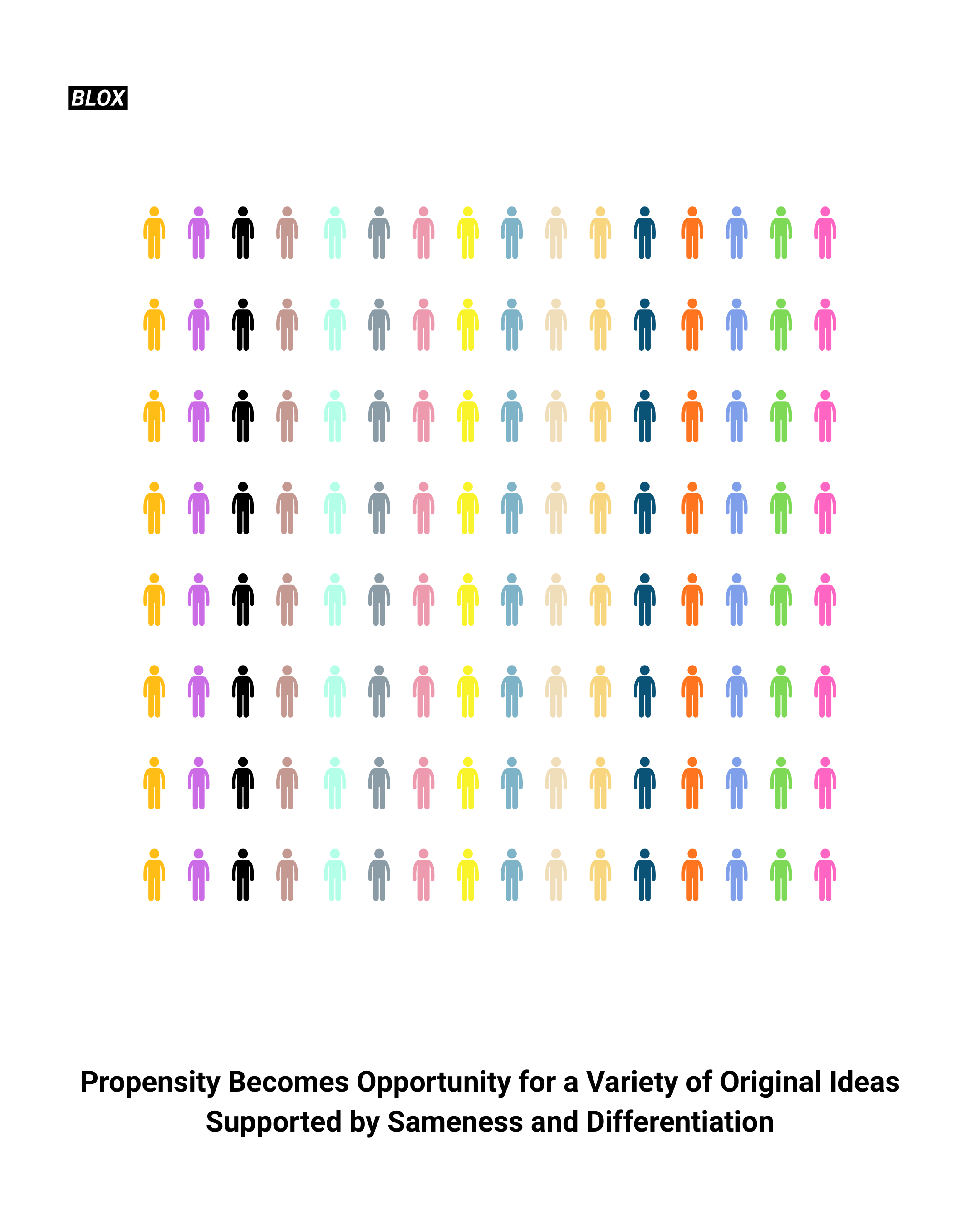
Once the outlier identifies the pattern, a new opportunity arises to stand along the same plane as other outliers that are recognizably different.
This is where standardization can be simplified, because standards are incredibly useful. They allow brands to scale quality, create benchmarks, establish expectations and reduce uncertainty. But every measurement system contains assumptions about what deserves to be measured. When something falls outside those assumptions, the system may struggle to evaluate it fairly. The outlier isn't necessarily worse. It is simply harder to classify. That distinction matters enormously in business. Organizations frequently optimize toward what can be recognized, benchmarked, approved, and explained, rather than what could create a degree of separation from similarity.
The marketing paradox: recognition versus distinction
Marketing lives directly inside this tension. A brand has to resemble its category enough for people to understand what it is. But it also has to create enough difference for people to remember why they should choose it. This is where sameness and differentiation stop being opposites. Some sameness is useful. It provides context. Difference provides meaning.
Research from the Ehrenberg-Bass Institute distinguishes between ordinary brand elements and distinctive assets: colours, typography, logos, characters, sounds and other cues that become strongly and uniquely associated with a particular brand. Their research emphasizes that distinctiveness isn't simply about making something visually unusual. The asset has to become recognizable as yours.
That distinction is critical.
Being different isn't the goal. Being recognizably different is.
Kantar's analysis adds another commercial dimension. Its research across 40,000 brands found a strong relationship between relative uniqueness and consumers' willingness to pay more. In Canada specifically, Kantar reported in 2025 that brands increasing their "Meaningful Difference" achieved approximately twice the brand-value growth of brands whose Meaningful Difference declined. So the business question isn't:
How different can we be?
It's:
How much familiarity does the market need to understand us - and where can difference create disproportionate value?
AI is making this tension more important
There is another force accelerating the sameness trajectory: scale. For example, marketing teams are being asked to produce extraordinary quantities of content. Adobe reported in 2025 that 96% of surveyed marketers had experienced at least a doubling of content demand over the previous two years, while 62% reported demand increasing fivefold or more. 71% expected content demand to increase more than fivefold again by 2027. Generative AI offers an obvious solution. It can help organizations research, write, design, personalize and produce at a speed that would previously have required much larger teams. But speed creates a strategic question.
If organizations use the same tools, trained on overlapping bodies of information, prompted using the same best practices and optimized toward the same platform conventions, what happens to the range of outputs?
Efficiency can scale originality. It can also scale convention. Templates accelerate production because someone has already made hundreds of decisions for us. AI can do something similar. And the easier legitimacy becomes to reproduce, the more valuable genuine identity may become. The competitive advantage won't necessarily belong to the organization that produces the most. It may belong to the organization with the clearest system for determining what should remain consistent and what should never become generic.
How sameness shows up in three markets
The balance between convention and difference changes depending on the market.
Industrial + Construction: credibility before creativity
Industrial, construction and AEC organizations have legitimate reasons for conservatism. Their buyers often care about technical competence, safety, experience, specifications, reliability and execution. In these environments, familiar signals can reduce perceived risk.
The opportunity isn't to abandon those credibility-first instincts. It's to test whether calculated creativity can increase trust rather than threaten it.
That could mean stronger technical storytelling. Better visualization of expertise. More distinctive thought leadership. A clearer digital experience. A brand system competitors don't immediately resemble. The objective isn't disruption for disruption's sake. It’s to meet the industry where it is. Push gently. Don't ask it to leap.
Legacy businesses: modernize without erasing memory
For established organizations, sameness can represent something very different. It can represent continuity. A logo, colour, phrase, process or visual style may carry decades of accumulated recognition. What looks dated to an internal marketing team may still hold enormous memory value in the market.
Research into distinctive brand assets reinforces the importance of understanding what consumers have actually encoded into long-term memory before discarding familiar brand elements.
Modernization therefore shouldn't automatically mean replacement. It can mean cataloguing what deserves to survive. What elements are merely old? What elements are genuinely recognizable? What represents the company's history? What still communicates value? What has become noise? What could be reinterpreted rather than removed?
Legacy businesses don't need to choose between heritage and relevance. The better challenge is to determine which pieces of the past can become distinctive assets for the future.
Growth-stage companies: speed without identity collapse
Startups face almost the opposite problem. Speed creates convergence. The gradient. The oversized sans-serif headline. The three benefit cards. The social-proof strip. The familiar CTA. The AI-assisted copy.
None of these things are inherently bad. In fact, conventions often exist because they work.
But when every organization borrows the same signals of legitimacy, legitimacy and identity begin to look remarkably similar. For growth-stage companies, the opportunity is therefore to separate operational efficiency from creative conformity. Use templates where templates save time. Use AI where AI creates leverage. Use proven UX patterns where familiarity reduces friction. But identify the places where sameness carries a strategic cost.
Because if every competitor communicates credibility using exactly the same visual and verbal language, distinctiveness itself becomes increasingly scarce. And scarcity creates value.
The answer isn't differentiation everywhere
This brings us to an important point. A completely differentiated business would probably be exhausting. Imagine a website where navigation worked differently from every other website you've visited. A proposal structured unlike any proposal you've read. A checkout process you had to learn. New terminology for familiar services. Unexpected interactions everywhere.
Difference creates cognitive cost. That's why the objective shouldn't be maximum differentiation. It should be calculated difference. Standardize the things that benefit from familiarity. Differentiate the things that create meaning.
That could be thought of as a simple operating principle:
Familiarity creates access.
Distinctiveness creates recognition.
Difference creates preference.
The strongest organizations understand where each belongs.
From cataloguing sameness to documenting difference
Perhaps this gives us a different way to think about brand systems. Traditionally, organizations document consistency.
Here are our colours.
Here are our fonts.
Here is our logo.
Here is our tone.
Here is our template.
Here is how everything should look.
That documentation matters. Consistent use of distinctive brand assets can improve cohesion and help build mental availability, according to Ehrenberg-Bass research. But what if organizations also documented their difference?
What do we believe that competitors don't?
What do we understand unusually well?
What processes have we developed ourselves?
What parts of our history could nobody else authentically claim?
Where are we intentionally conventional?
Where are we intentionally unconventional?
Which colours, words, behaviours, experiences and ideas should become uniquely associated with us?
What should AI be allowed to standardize?
And what should it never flatten?
This turns brand governance from a system designed only to enforce consistency into one designed to protect meaningful variation.
The opportunity is a spectrum, not an outlier
This is what the final graphic represents. Once difference can be understood, documented and measured, the outlier no longer needs to sit outside the system. The system itself can become more diverse.
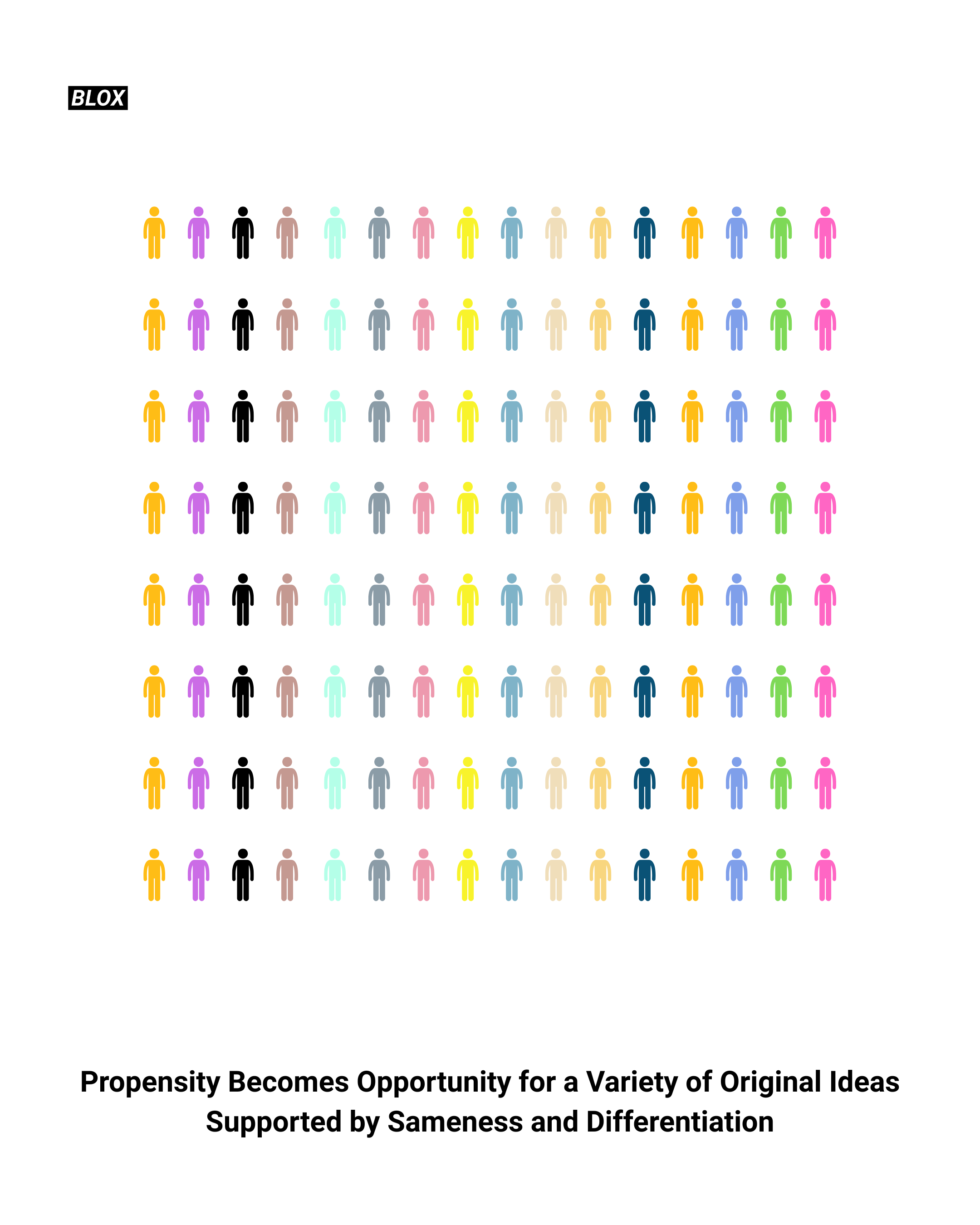
It’s a natural urge or tendency to act or feel in a specific way.
We retain enough common language to understand one another while developing enough specificity to communicate meaningful variation. Markets can work the same way. The goal isn't to eliminate category conventions. It is to create enough room inside them for organizations to develop identities that are recognizable without becoming interchangeable.
The strategic advantage of calculated difference
Sameness optimizes for speed of recognition - by a buyer, algorithm, procurement team, approval committee, investor or funder. Sometimes that's exactly what a business needs. But recognition and preference aren't the same thing. The next generation of strong brands may therefore need to become better at managing the space between them. Not different simply to attract attention. Not conventional simply to avoid risk. But deliberate about both.
Purposeful organizations don't need to look identical to their competitors to be trusted. They need frameworks that make calculated difference legible rather than risky.
That is the balance. Honour what's proven. Document what matters. Use familiar structures where they create clarity. And protect enough originality that people still have a reason to choose you. Because in a sea of sameness, standing apart doesn't have to mean standing alone. It means being different enough to be remembered - and connected enough to be understood.
Frequently Asked Questions
Why do brands in the same industry often look alike?
Brands converge because familiar visual, verbal and structural conventions make them easier for customers and stakeholders to categorize. Similarity can reduce the effort required to understand what a company does and can signal category legitimacy. The risk is that excessive convergence makes competitors increasingly interchangeable.
Is brand consistency the same as brand sameness?
No. Consistency means repeatedly expressing recognizable elements of your own identity. Sameness means increasingly resembling the conventions of everyone else. A strong brand can be highly consistent while remaining highly distinctive.
Why is brand differentiation important?
Differentiation gives customers a reason to prefer one organization over another. Kantar research has linked perceived difference with stronger growth potential and greater willingness to pay, while distinctive brand assets can help people recognize a brand more easily.
Can a brand be too different?
Yes. Difference can create cognitive friction when customers no longer understand what an organization does, how to navigate its experience or how to evaluate its offer. Effective differentiation preserves enough familiar category cues to make the organization understandable while creating meaningful points of distinction.
How does AI affect brand differentiation?
AI can dramatically increase the speed and volume of marketing production. But organizations using similar tools, templates, prompts and conventions may also produce increasingly similar outputs. The strategic opportunity is to use AI for efficiency while maintaining clear human-defined brand principles, proprietary thinking and distinctive assets.
What is calculated difference?
Calculated difference is the deliberate choice to preserve familiar conventions where they improve comprehension or trust while differentiating the elements that influence recognition, meaning and preference. It treats differentiation as a strategic decision rather than a creative exercise.
I hope you enjoyed this post.
Thanks for reading!
Blox
Blox Communications is a creative-technical marketing consultancy based in Langford, BC, helping purposeful organizations modernize their brands, build smarter marketing systems, and integrate AI into their sales and communication.

Don't Be Too Perfect: What Stock Imagery Teaches Us About Trust
Stock imagery still works in modern brand marketing - but only when it's curated for authenticity, features real people, and avoids heavy filtering. Audiences increasingly distrust polished, staged, or "too perfect" visuals, and that same instinct toward over-polish quietly undermines decisions well beyond the photo library.
Quick answer: Stock imagery still works in modern brand marketing - but only when it's curated for authenticity, features real people, and avoids heavy filtering. Audiences increasingly distrust polished, staged, or "too perfect" visuals, and that same instinct toward over-polish quietly undermines decisions well beyond the photo library.
The old "handshake in a boardroom" stock photo never built trust. It built distance.
That's not a stylistic complaint - it's a measurable one. Audiences register a staged photo as staged before they've consciously processed the message sitting next to it, and that split-second judgment shapes whether they lean in or scroll past. The uncomfortable irony is that many businesses reach for stock imagery specifically to build credibility, and end up doing the opposite. Just when a leadership team thinks, "we should add some photography to the site," they may, in fact, be subtracting from the trust they set out to build.
This matters more than it sounds like it should. Visual perception research consistently shows that people process and retain images far faster than text - and in a marketplace where attention is the scarcest resource a brand has, the image is frequently doing more persuasive work than the copy around it. Getting imagery strategy wrong isn't a design footnote. It's a trust-and-conversion problem with a direct line to the P&L.
What Is the Right Strategy for Using Stock Imagery?
The strategy outperforming everything else right now is what we call curated authenticity: deliberately blending licensed stock photography with real, brand-specific photography or user-generated-style content, so that no single image reads as though it came from a generic "10 free business photos" folder.
This isn't a preference or a passing aesthetic trend - it's where buyer expectations have settled. Audiences increasingly want visual content that feels genuine, closer to something an actual person captured in the field than a stereotypical stock photo, and the clearest pattern across current research is a strong preference for unedited, candid, and realistic imagery that reflects diversity and real-life scenarios over anything visibly staged.
For any brand under pressure to modernize - and for the businesses we work with directly - that means treating imagery as a strategic asset rather than a placeholder. Not "which stock photo fits the layout," but "which image, real or licensed, will hold up to five seconds of audience scrutiny without breaking the illusion of authenticity."
How Does Imagery Strategy Change by Industry?
Imagery strategy isn't industry-agnostic, and treating it as if it were is one of the more common - and more expensive - mistakes brands make.
At Blox, we work primarily with trades, contractors, and legacy-to-growth businesses undergoing modernization. For that audience, imagery strategy has to succeed on two fronts simultaneously:
Speak the audience's world back to them. Job sites, real hands, real tools, weathered gear - not generic "corporate synergy" stock that could belong to any industry, in any decade.
Model the aesthetic you're asking the client to adopt. A consultancy pitching craft-forward, tactile modernization work loses credibility the moment its own imagery looks like it was pulled from a template.
A mismatch between a brand's stated positioning and its visual execution is one of the fastest ways to undercut a pitch - often before a single word of copy has been read. The industry context doesn't just inform which photos you choose; it determines whether the entire visual narrative is believable.
What Does the Right Imagery Do for Your Audience?
The right imagery functions as a trust shortcut. It compresses the work of persuasion into a fraction of a second.
The underlying mechanics are well established: roughly 67% of e-commerce shoppers say image quality is "very important" to their purchase decision, and people generally retain about 65% of what they see in an image, compared to roughly 10% of what they hear. In practice, this means the image is often carrying more of the argument than the surrounding copy - which is precisely why treating imagery as an afterthought, rather than a strategic input, is a costly oversight.
There's a business-performance dimension here too, not just a perceptual one. Poor or mismatched imagery slows page engagement, increases bounce, and signals - consciously or not - that a brand hasn't invested the same rigour in its visual presentation that it claims to bring to its actual work. For a modernization-focused consultancy, that's a particularly expensive signal to send by accident.
Why Is It Important to Have Images of People?
This is one of the more consistently replicated findings in marketing and consumer psychology, and it holds across platforms, industries, and study designs:
Photos featuring human faces are 38% more likely to receive likes and 32% more likely to receive comments on social platforms, even after controlling for audience reach.
Websites that include human faces are received more positively than those with no facial features or no people at all - and the effect shows up specifically as an initial-trust judgment, formed within seconds of first exposure.
Human photography, compared with illustration, generates greater interest and stronger perceived credibility - particularly around attractiveness and trustworthiness - and that credibility carries through measurably to brand attitude and purchase behaviour.
The strategic takeaway is straightforward: audiences trust a face before they trust a claim. A well-placed, unposed human image can do more to establish credibility in the first three seconds of a visit than an entire paragraph of positioning language can do in the next three minutes.
Why Do Filters Matter?
Filters are where authenticity is won or lost. Heavy filtering reads as "stock" almost instantly - it functions as the visual equivalent of corporate jargon: technically polished, but immediately recognizable as manufactured, and quietly damaging to the credibility of everything around it.
Current consumer sentiment is explicitly skeptical of over-polish. Audiences are increasingly wary of imagery that looks "too perfect," which is a substantial part of why unedited, candid photography continues to outperform glossy, heavily processed stock. This doesn't mean brands should abandon visual consistency - light, deliberate colour grading in service of a cohesive brand identity remains sound practice. The failure mode is different: airbrushed, oversaturated, or obviously templated filtering signals "not real" to the viewer, and that signal directly undercuts the trust effect the image was meant to build in the first place.
Put simply: consistency is a brand asset. Artificial perfection is a liability.
The Broader Business Case: Why "Good Enough, Shipped" Beats "Perfect, Delayed"
Here's where the imagery lesson stops being about imagery.
The instinct that drives a brand to re-shoot the photo, re-filter the smile, or re-stage the shot until it looks flawless is the same instinct that stalls a strategy deck, delays a product launch, or holds back a campaign past its market window. It's the same underlying fear - of being judged, of falling short of an invisible standard - expressed in a different medium.
This pattern has real organizational cost, and it shows up in three predictable ways:
Missed timing. Teams that refine a deck, product, or campaign past the point of diminishing returns routinely lose the market window to a competitor willing to ship something merely good enough. Perfectionism doesn't just slow output - it cedes first-mover advantage to whoever is comfortable moving with less certainty.
Suppressed risk-taking. When the internal standard is flawlessness, people quietly stop proposing bold ideas, because bold ideas fail more visibly, and visible failure is precisely what the perfectionist standard punishes. Over time, the organization trades innovation for safety - without any single person, or any single meeting, ever consciously deciding to make that trade.
Erosion of internal trust and velocity. Work held back for "one more round of polish" bottlenecks through a single decision-maker, and teams learn - implicitly - that shipping is dangerous and stalling is safe. That lesson compounds. It slows the organization long after the original piece of work has shipped or died on the vine.
The businesses that move fastest, and that build the deepest trust - with audiences, with clients, and internally with their own teams - are consistently the ones willing to be good in public rather than perfect in private. That principle applies as much to a homepage photo as it does to a product roadmap.
A Quick Framework for Auditing Your Own Brand Imagery
If you want to stress-test your current visual library, ask these four questions of every image before it goes live:
Does it feature a real, unposed-looking person wherever possible? If not, is there a strategic reason a person isn't present?
Would a member of your actual target audience recognize their own world in this image - their tools, their setting, their context - or does it feel generic enough to belong to any industry?
Is the editing invisible? Light, consistent colour grading is fine. If the filtering itself is the first thing a viewer notices, it's already working against you.
Would you be comfortable if this image were slightly imperfect - a candid expression, an unposed angle, a real environment - rather than airbrushed into "perfect"? If the answer is no, that discomfort is worth examining on its own.
Frequently Asked Questions
Does stock photography still have a place in modern brand marketing? Yes. Stock photography remains a viable, cost-efficient tool, but it performs best when blended with real, brand-specific photography rather than used on its own. Fully generic stock reads as filler; curated, industry-relevant imagery paired with real people and real context reads as intentional.
Why do images with people perform better than product-only or illustrated images? Human faces produce an immediate, measurable effect on trust and engagement - more likes, more comments, and faster first impressions of credibility - that product-only or illustrated imagery does not reliably replicate. This effect is well documented across social media engagement studies and website-trust research alike.
Is it bad to edit or filter photos at all? No. Light, consistent colour grading that reinforces a cohesive brand identity is normal and advisable. The failure point is over-editing to the degree that an image looks manufactured rather than real - that's the exact threshold at which audience trust begins to erode.
How does stock imagery strategy differ across industries? It differs primarily in what "authentic" looks like for that audience. A trades or manufacturing audience needs to see their own working environment reflected back to them - tools, sites, hands-on context - while a luxury or professional-services audience may need a different visual register entirely. The common thread across every industry is the same: the imagery has to be believable to the specific person looking at it.
How does this connect to perfectionism in business more broadly? The instinct to over-polish an image and the instinct to over-refine a deck, product, or campaign originate from the same underlying fear - visible failure. Both slow decision-making down, and both can, ironically, cost the organization the very trust or market opportunity it was trying to protect by waiting for "perfect."
What's the single highest-leverage change a brand can make to its imagery today? Replace one generic, obviously staged stock photo - the boardroom handshake, the overly posed team shot - with a real, unfiltered image of an actual person in your actual context. The trust differential shows up immediately, and it's usually the cheapest brand improvement available.
The Bottom Line
Imagery strategy is not a design decision - it's a trust decision, and trust decisions have measurable business consequences. Audiences form credibility judgments about a brand before they read a word of its messaging, and those judgments are disproportionately shaped by whether an image feels real or manufactured. The same discipline that governs good imagery - restraint, authenticity, a willingness to ship something honest rather than something flawless - is the same discipline that separates organizations that compound trust over time from those that quietly lose it, one over-polished decision at a time.
We hope this gave you a new way to think about the pictures on your website - and maybe a few other decisions too.
Thanks for reading!
Blox
Blox Communications is a creative-technical marketing consultancy based in Langford, BC, helping purposeful organizations modernize their brands, build smarter marketing systems, and integrate AI into their sales and communication.
Why Print Still Wins in ABM: The Case for Tactile Outreach
In a market where the average decision-maker's inbox is already a battlefield, a physical, tactile object that lands on the right desk at the right moment commands a different kind of attention.
Here at Blox, we love to print stuff. It comes from many, many years of experience our Founder, Chona, has in printmaking. She doesn’t always talk about it, but she earned an honours degree in Printmaking in the early 2000s. But her love for print even precedes that. She remembers as a child observing the wallpaper on her bedroom walls. Both her mom and dad were extremely creative, and their eye for dimension, composition, and alignment reflected in every piece of photography, art, and design that permeated their home. So, as you can see, print is a foundation that has now impacted Blox Communications.
Did you know that print collateral outperforms purely digital outreach in account-based marketing (ABM) because it's harder to ignore, easier to remember, and signals personalization in a way a screen can't? At Blox Communications, ABM-driven campaigns built around printed materials have delivered up to 22x marketing ROI and a 29% conversion rate - compared to the 1-2% typical of broader, untargeted outreach.
Most agencies treat print as an afterthought: a checkbox at the end of a digital strategy. At Blox, it's part of the strategy itself.
What is ABM (Account-Based Marketing), and Why Does Print Matter to it?
Account-based marketing flips the traditional funnel. Instead of casting a wide net and filtering leads down, ABM starts with a short list of high-value prospects and builds specific, high-touch material for each one. It's precision over volume.
That precision is exactly where print earns its place. A broad email campaign can be personalized with a name and a company logo. A printed piece - a custom one-pager, a branded postcard, a sticker sheet built around a prospect's own brand language - says something a digital touchpoint can't: we built this for you specifically, not we built this for everyone on this list.
In a market where the average decision-maker's inbox is already a battlefield, a physical, tactile object that lands on the right desk at the right moment commands a different kind of attention. It doesn't compete with forty other browser tabs. It sits there. It gets picked up. It gets shown to a colleague.
3 Ways Print Collateral Drives Engagement, Awareness, and Conversion in ABM
1 - Engagement: Getting Noticed in a Crowded Inbox
Digital fatigue is real. Decision-makers filter out cold emails and generic ads almost on instinct. A well-crafted printed piece bypasses that filter entirely - it's a physical interruption in a digital routine, which makes it inherently more memorable and more likely to prompt a reply or a follow-up call.
2 - Awareness: Building a Brand Impression That Sticks
Composition, paper stock, finish, the way a sticker peels or a booklet folds open - these aren't decorative details. They're brand signals. A beautifully made piece communicates craft and intention before a prospect reads a single word, building brand awareness faster and more durably than a digital ad impression that disappears the moment someone scrolls past.
3 - Conversion: Turning Attention Into Action
This is where the strategy pays off in hard numbers. ABM campaigns that incorporate printed collateral as a core lever have produced:
Up to 22x marketing ROI
A 29% conversion rate, compared to the 1-2% typical of broader, non-targeted outreach
The gap isn't incidental. High-touch, physically delivered material reaches prospects who've already been filtered for fit and value, and it does so in a format designed specifically for them - which is precisely the combination that moves a prospect from aware to engaged to converted.
How Blox Approaches Print in the Sales and Marketing Process
At Blox, every piece of work runs through three pillars: creativity, strategy, and execution.
Creativity is the spark - the bold concept, the unexpected visual, the line that sticks.
Strategy is the architecture underneath it - the frameworks that make sure the creative actually moves the needle, not just looks good.
Execution is where it becomes real, and print lives almost entirely in this third pillar - though a great printed piece has to be designed with intention and built on strategy before it's ever physically delivered.
In practice, that's meant producing an extensive range of materials for ABM and brand-awareness programs: stickers, business cards, service booklets, handbills, accordion flyers, postcards, one-pagers, and individually built ABM pieces designed around specific prospects. It also extends to internal brand tools, like the printed Blox Brand Compass booklet below, a Blox Framework-built ASSET used to align a client’s sales and brand vision, mission, values, and purpose.

Pages extracted from our official Blox Brand Compass built using the Brand Compass Framework.
Why the Print Partner Matters
The strategy behind a piece only matters if the execution holds up - and execution depends on who's running the press. For Blox, that partner is Little Rock Printing.
When you're running a fast-moving company, you can't afford a printer who's inconsistent or slow to communicate. Little Rock has been dependable on every project, with consistently excellent quality, and the team has been genuinely supportive of a small business finding its footing - including a small-business discount that's made it possible to print more, more often, without compromising on quality. That kind of reliability is what makes it possible to run print as a real strategic lever rather than a risk: stickers, business cards, service booklets, handbills, accordion flyers, postcards, one-pagers, and individually built ABM pieces all need to land exactly right, on schedule, every time.
It's less of a vendor relationship and more of a working partnership - one that's become part of how Blox delivers on its promise to clients.

A couple of posters showcasing some print collateral printed by our trusted print vendor Little Rock Printing.
Where AI Fits Into the Print Process
AI integration is one of Blox's three core service modules, alongside brand/marketing and sales process, and it plays a direct role in how printed ABM material is made. AI tools are used throughout the creative process to generate concept variations, draft copy, and build visual mood boards, which dramatically speeds up the iteration cycle. Work that used to take days of back-and-forth now happens in hours.
That speed doesn't replace the craft of print - it feeds it. Faster iteration means more testing, more refinement, and ultimately a stronger finished asset by the time it goes to press. AI gets the idea to the final draft faster. Print is still where the idea becomes real.
Frequently Asked Questions
Does print collateral still work in a digital-first sales process? Yes - particularly in ABM, where the goal is depth of impression with a small number of high-value prospects rather than reach across a large audience. Print's tactile, physical nature makes it more memorable and harder to ignore than digital-only touchpoints.
What kind of ROI can print-supported ABM campaigns deliver? Blox's ABM campaigns that incorporate printed collateral have delivered up to 22x marketing ROI and a 29% conversion rate, compared to roughly 1-2% for broader, untargeted outreach.
What types of printed materials work best for ABM? Materials built specifically for an individual prospect or account tend to perform best - custom one-pagers, branded postcards, sticker sheets, and service booklets designed around a prospect's own brand language, rather than generic, mass-produced collateral.
Does using AI in the creative process compromise the quality of printed materials? No. AI is used earlier in the process - for concept generation, copy drafting, and moodboarding - which speeds up iteration before anything goes to print. The physical production itself (paper stock, finish, construction) remains a separate, craft-driven step.
We hope this post has helped you understand the role print plays in running a consultancy!
Thanks for reading!
Blox
Blox Communications is a creative-technical marketing consultancy based in Langford, BC, helping purposeful organizations modernize their brands, build smarter marketing systems, and integrate AI into their sales and communication.
Just a Moment for AI
AI does not create capability in isolation - it amplifies the structure that already exists; it makes our existence within the structure more significant.
Take a deep breath and think deeply. AI is becoming the structure of our world, no matter what shape or form that world takes. We are all witnessing it reshape how we think, create, decide, and execute. It’s enabling us to move faster, operate more efficiently, and, in some cases, reach a level of thoroughness that traditional processes struggle to match.
So, let’s start at square one. Why does the philosophical connection matter?
AI’s philosophical connection matters because it defines how we relate to technology - not just how we use it, but our relationship to it. It also challenges the assumption that intelligence is purely human. When a system can generate ideas, synthesize knowledge, and simulate reasoning, it pushes us to ask: What is original thought? Where does meaning actually come from? In that sense, AI becomes a kind of mirror - reflecting patterns, assumptions, and oversights, making our thinking more visible to a trained eye. But it’s not a perfect reflection. What it returns is shaped as much by the system as by us, which can create the illusion of truth when we’re really seeing a constructed projection. Used carelessly, that can blur our sense of authorship and originality. Used well, it can bring us closer to our new reality.
To elaborate.
AI may be blurring the boundary between information and discernment. While it can process, combine, and produce at scale, it lacks intent, belief, and accountability. It also doesn’t pass judgment, exhibit taste, or display empathy. These distinctions form what Blox calls your ‘Competitive Edge’. And note, these distinctions elevate us. They advance our critical thinking abilities. We move from being the primary producers of output to the editors of meaning - deciding what matters, what's true, and what should be acted on. Most don’t see it this way, but AI gives us secret powers; it’s just a matter of recognizing them and using our self-awareness to do better work - on purpose.
And what about practicality?
In practice, AI reduces friction in how work gets done. It takes on the repetitive, time-consuming parts of work - research, synthesis, drafting, data processing - so people can focus on higher-value thinking. Instead of spending hours gathering and organizing information, you move more quickly to interpretation and decision-making - traits that might differ between man and machine.
And just to be direct about our positioning, we are on the side of humanness - because while AI compresses time, it’s still up to us to decide what that time is worth. Tasks that used to take days - thinking up social media content, writing a report, analyzing trends, building a presentation - can now be done in hours. That doesn't just make humans faster; it changes how often we can iterate. More cycles, better outcomes. But wait, more work? We need to remember that those outcomes won’t magically explain themselves. That’s why some say AI improves collaboration. Now that we have more time to share, debate, waffle, and construct our ideas, they should carry more weight, and this, in turn, should augment our human capacity to learn.
So…
The distinction is hopefully becoming clear. Used as a shortcut, AI delivers increments. Used as a system, it compounds. Those who apply it sporadically, without understanding how to shape context or guide its output, will plateau. Those who integrate it into how they think and act critically will see exponential returns.
Better thinking. Sharper intuition. More willed execution.
Because when AI handles the production of information, what’s left is what matters most: how you interpret it, how you challenge it, and how you decide what to do with it. Thinking becomes less about generating answers and more about refining them. Intuition strengthens as you recognize patterns faster and question them more deeply. And execution improves because decisions are made with belief, empathy, judgment, accountability, taste, and intent, not just efficiency.
That’s the shift. To be in a mutually beneficial relationship with technology, not taking advantage of it, but giving and taking fairly, like how you would in a good marriage. Let’s look at how AI works with real people doing real life stuff.
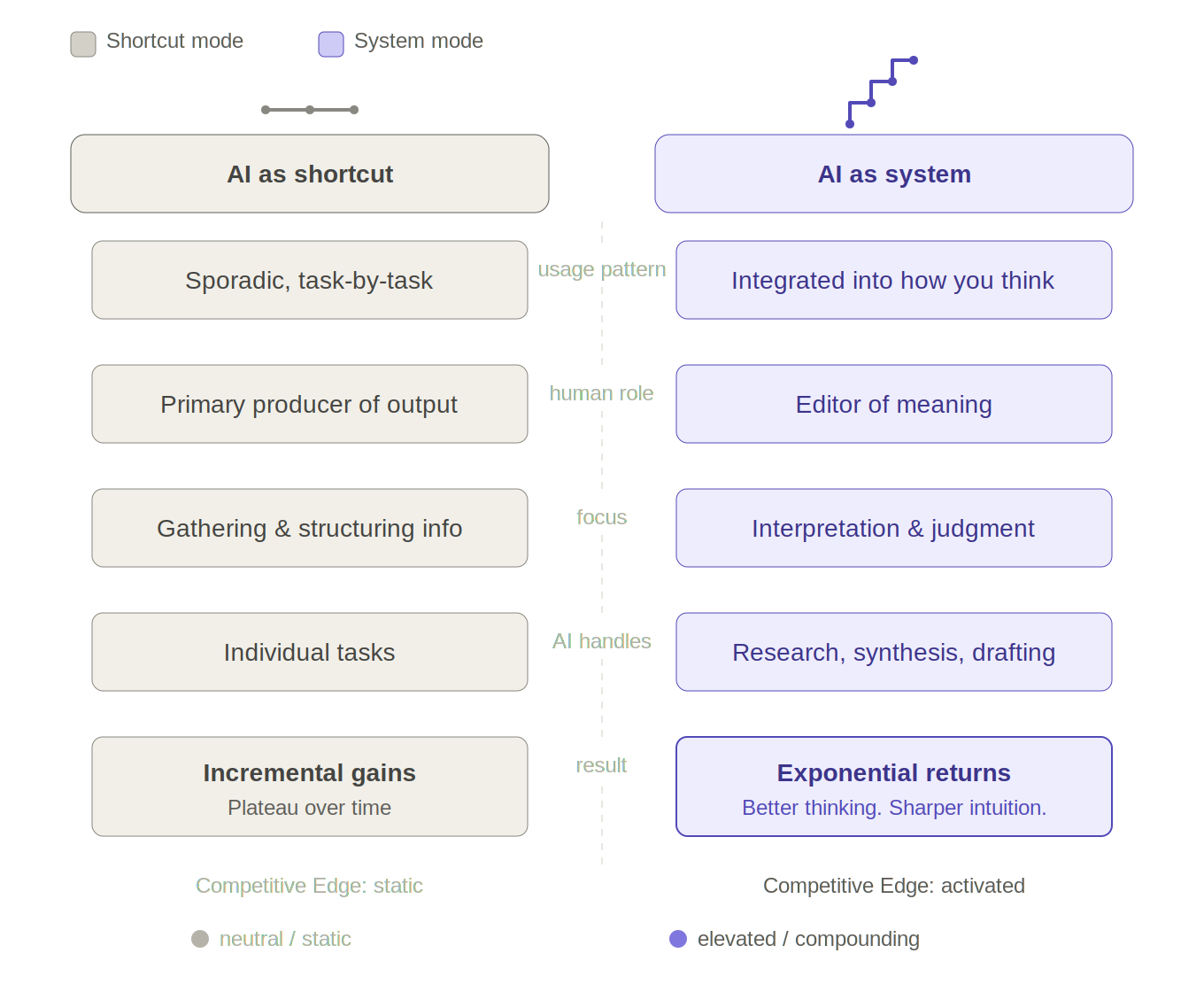
A side-by-side comparison showing how sporadic AI use leads to incremental gains and plateau, while integrating AI as a system unlocks exponential returns and activates your Competitive Edge.
Here's example 1 of a marketing manager’s workflow to write a technical white paper:
Step 1 - Frame the topic and structure
Tools: ChatGPT, Perplexity AI, Claude
Pressure-test angles: "What are the most credible narratives in this space?"
Pull recent sources, reports, and citations
Build a structured outline (sections, arguments, flow)
Benefit: Faster clarity and stronger initial framing
Risk: Over-reliance on generic angles if not guided well, or applying critical thinking
Step 2 - Research synthesis
Tools: Perplexity AI, Elicit
Aggregate research papers, industry reports, and data
Summarize key findings and extract patterns
Cross-check sources manually for credibility
Benefit: Compresses hours of research into minutes
Risk: Missing nuance or misinterpreting source material
Step 3 - First draft development
Tools: ChatGPT
Feed structured outline + key points into ChatGPT
Generate rough sections (not final copy)
Focus on flow, completeness, and logical sequencing
Benefit: Eliminates blank page problem; accelerates momentum
Risk: Voice becomes flat or overly generalized
Step 4 - Refinement and editing
Tools: Grammarly, ChatGPT
Review for clarity, grammar, and tone
Tighten arguments, simplify language, or reframe sections
Manually inject brand voice, opinion, and specificity
Benefit: Higher clarity and readability with less effort
Risk: Over-polishing can remove distinctiveness
Step 5 - Final review and positioning
Tools: Human judgment, taste, and aligning intention (this is the differentiator)
Ensure claims are accurate and defensible
Align with brand narrative and strategic intent
Validate that insights are original enough to be valuable
Benefit: Maintains credibility and authority
Risk: If skipped, the content feels generic and interchangeable
Here's example 2 of a visual artist’s workflow to understand and apply colour theory:
Step 1 - Research colour theory foundations
Tools: Perplexity AI, Elicit
Explore core principles (contrast, harmony, saturation, psychological impact)
Surface historical frameworks (Bauhaus, Itten, Albers)
Pull references from academic and art theory sources
Benefit: Rapid access to structured knowledge and historical context
Risk: Oversimplification of nuanced theory or missing deeper interpretation
Step 2- Study predecessors and movements
Tools: ChatGPT, Google Arts & Culture
Identify key artists and movements (Impressionism, De Stijl, Abstract Expressionism)
Analyze how colour was used intentionally across eras
Compare approaches (emotional vs. structural vs. symbolic use of colour)
Benefit: Faster pattern recognition across art history
Risk: Flattening distinct movements into generalized summaries
Step 3 - Translate theory into a postmodern application
Tools: ChatGPT
Prompt explorations like: "How would Josef Albers approach colour in a digital/postmodern context?"
Generate conceptual directions that blend structure with disruption
Explore contrast, irony, fragmentation, or reinterpretation of traditional palettes
Benefit: Expands conceptual range and reframes traditional ideas
Risk: Outputs can feel derivative without a strong artistic direction
Step 4 - Visual experimentation and iteration
Tools: Midjourney, Adobe Firefly
Generate visual studies based on colour prompts and themes
Test combinations, gradients, clashes, and unexpected palettes
Use outputs as references or starting points - not final work
Benefit: Rapid iteration and exploration of visual possibilities
Risk: Style homogenization or over-reliance on generated aesthetics
Step 5 - Refinement and artistic integration
Tools: Adobe Photoshop, Procreate
Reinterpret AI-generated ideas through your own process
Adjust colour relationships, composition, and texture manually
Anchor the work in your personal style and ensure it meets your goal
Benefit: Maintains authorship while leveraging AI for exploration
Risk: Losing originality if AI output is used too literally
I hope those examples were helpful.
Just so you know, this article came to light as I was creating a carousel for LinkedIn around three areas where AI is reshaping how work gets done. Let’s wrap up the article and review it here.
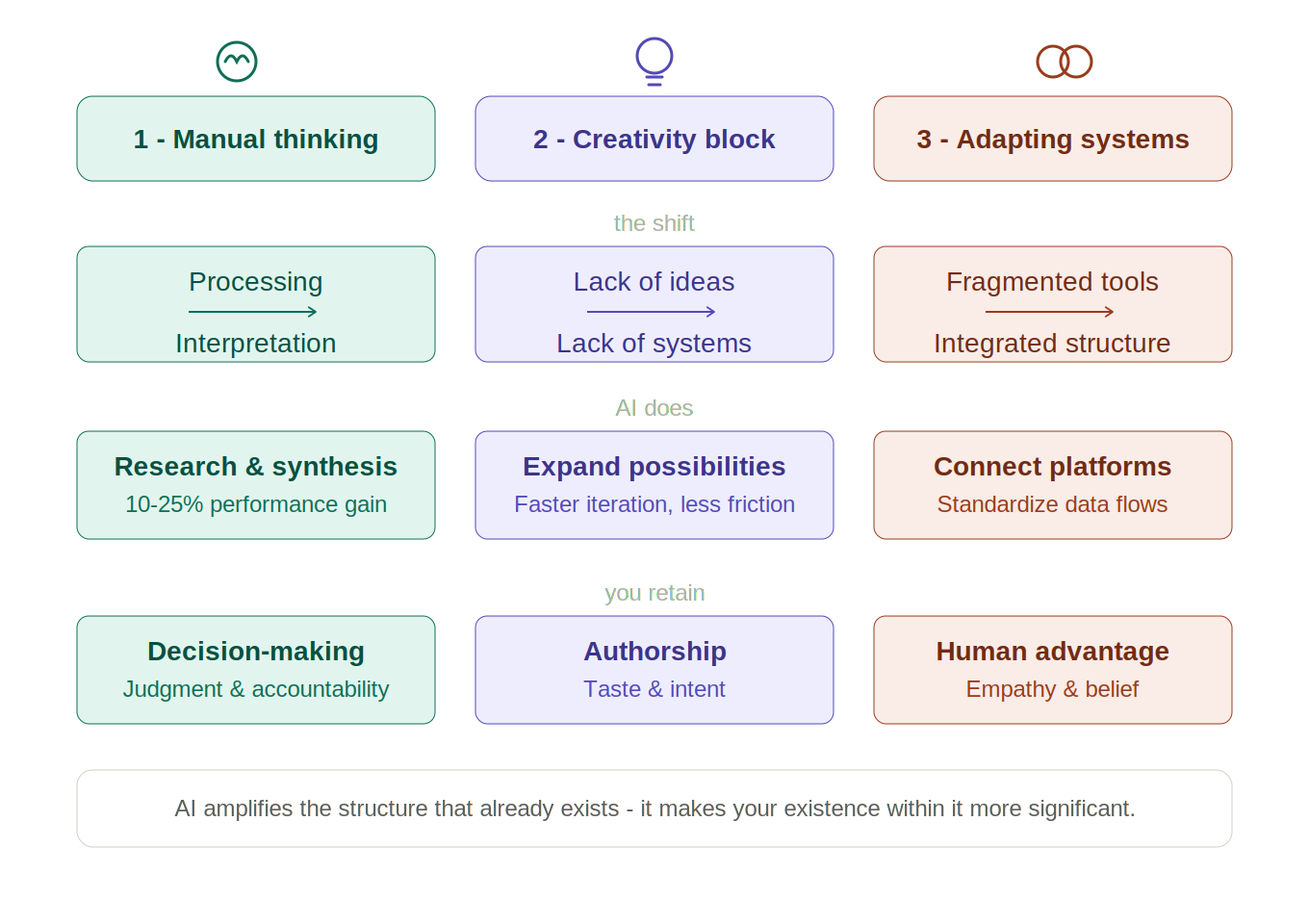
A three-column breakdown of how AI reshapes Manual Thinking, Creativity, and Systems - showing the shift each requires, what AI takes on, and what humans retain as their Competitive Edge.
1 – Manual Thinking
AI shifts the burden from processing to interpretation. Studies show performance gains of roughly 10–25% in common knowledge tasks like writing, research, and coding when AI is used effectively. More importantly, it reallocates attention: instead of spending time gathering, structuring, and synthesizing information, we can move more quickly to judgment and decision-making, removing the shackles of demand and giving us a sense of freedom. This is where the real leverage sits. Yet many people and organizations are not there - only a small minority describe themselves as fully AI-integrated across workflows, suggesting the gap is not access or even application - it's a reluctance to embrace what modernization requires.
2 – Creativity Block
When it comes to creativity, AI cannot replace it - it does, however, expand the surface area of possibility. AI is not here to generate the final output. It’s more about supporting iteration: reframing challenges, surfacing alternatives, and reducing the time to production. In practice, this means we can move through more ideas faster with less friction. The implication is subtle but important: creative blocks are no longer just about a lack of ideas, but about a lack of modern systems to support new and modern ideas. With tools like Midjourney and Canva, creators can go from idea to structured design to usable asset in shorter periods. Of course, this questions the entire notion of being creative - artists might want a long and difficult artistic process (I know this, because I have been a practicing artist). What that actually says about us is another topic.
3 – Adapting Systems
Let’s move forward and examine how AI shapes a legacy organization - directly aligning with our third core area: adapting systems. Many companies operate within a “modernization gap,” where fragmented tools, disconnected data, and inconsistent workflows quietly limit their ability to evolve. Across marketing, sales, and customer experience, nearly an entire workday each week is lost to these inefficiencies. Applied strategically, AI becomes that structure we talked about - integrating platforms, standardizing data, and enabling information to move seamlessly across functions. Without that alignment, complexity compounds. With it, AI becomes a coordinating force, helping us activate our Competitive Edge in personal and professional settings.
My final words.
What emerges across all three areas is a pattern. Note: this will be constantly debated. AI does not create capability in isolation - it amplifies the structure that already exists; it makes our existence within the structure more significant. This helps explain the current divide: while roughly three-quarters of us already use AI, many people and organizations do not fully appreciate its implications. The constraint is not technological maturity, but understanding AI’s impact, paired with our empathetic value, so we can leave a strong impression behind and continue moving ahead. And in that, shape the structure we’re all learning to operate within.
Why Creativity Compounds - And Why It Matters for Modern Brands
Creativity is often described as a spark - an inspired moment, a breakthrough, a burst of imagination. But the more we study high-performing brands, the clearer it becomes: creativity isn't just a moment. It’s a well-structured system that allows us to share our most profound and meaningful thoughts and ideas with society as a whole. And when that system is applied consistently, its impact compounds over time.
Creativity is often described as a spark - an inspired moment, a breakthrough, a burst of imagination. But the more we study high-performing brands, the clearer it becomes: creativity isn't just a moment. It’s a well-structured system that allows us to share our most profound and meaningful thoughts and ideas with society as a whole. And when that system is applied consistently, its impact compounds over time.
A recent global study, the Compound Creativity Study, conducted by System1 Group with the Institute of Practitioners in Advertising (IPA), proves exactly that. The findings are powerful, especially for established brands looking to modernize without losing themselves in the background noise of our fast-paced, ever-changing world.
At Blox Communications, this research aligns with what we’ve been building all along: creativity made accessible, structured, and scalable.
Let’s break down what the study reveals:
1. Creativity Works Better When It’s Consistent
The study evaluated over 4,000 campaigns across 56 brands, and the results were striking:
Brands with the highest creative consistency achieved a 3.3-star rating, compared to 2.6 in the least consistent group.
These top performers also saw ongoing improvement - gaining +0.2 stars per year, while inconsistent brands saw no growth at all.
So, what can we learn from this? Consistency doesn’t limit creativity; it strengthens it. But for it to really work, brands must first lay a foundation, which involves our 4-phase service offering - Discover, Define, Design, and Deliver. And consistency is not about doing things the same way every time. It’s about the disciplined practice of presenting your brand in a unified, recognizable way across every touchpoint - visuals, voice, messaging, behaviours, and customer experiences. It ensures that no matter where someone encounters your brand, they understand who you are, what you stand for, and what to expect.
Over time, creative consistency builds familiarity, trust, and memorability. It allows your brand to compound in value over time. When brands reuse the right assets, maintain a steady strategic position and message, and build campaigns on a unified strategy, creativity becomes more impactful and easier for audiences to recall.
This becomes the foundation of brand memorability.
2. Creative Consistency Drives Real Business Results
For those who aren’t necessarily ‘creative’ or who don’t understand what it truly is, creativity can seem ‘fluffy’ or intangible. But here at Blox, we thrive on creativity. It serves as the base element that, when paired with foresight and insight, becomes highly measurable and trackable. Here’s a quick reminder about the difference between foresight and insight and why they should work together -
Foresight
Foresight is the practice of preparing for what’s ahead by understanding the forces shaping change.
It’s not about predicting the future - it’s about being ready for it. Foresight helps organizations recognize emerging patterns, shifting behaviours, and evolving expectations so they can make informed decisions today that strengthen their position tomorrow.
It turns uncertainty into preparedness, giving brands the clarity and confidence to adapt with intention rather than react under pressure.
Insight
Insight is the ability to understand what’s true right now.
It is grounded in data, research, audience behaviour, and lived experience. Insight reveals the motivations, gaps, and opportunities shaping current performance. It answers “What’s really happening today?” and turns observation into clarity.
Why Foresight and Insight Must Be Paired
Individually, foresight and insight are valuable. Together, they are transformative.
Insight grounds you in reality.
Foresight guides you toward possibility.
When paired, they create a complete decision-making system:
Insight shows why the brand performs the way it does now - the gaps, the behaviours, the inefficiencies, the opportunities hiding in plain sight.
Foresight shows what the brand will need to become - the future expectations of customers, the shifts coming to legacy sectors, the trends that will reshape markets, and the capabilities organizations must build to stay relevant.
For legacy brands especially, this pairing is essential:
Many rely on decades of experience (insight) but struggle to adapt quickly (lack of foresight).
Others see the future but lack the internal clarity to act (foresight without insight).
When the two intersect, companies gain something powerful: clarity about where they stand and confidence about where they’re going.
This is why Blox integrates both into our modernization frameworks - from the Blox Brand Audit (insight) to market research and trend analysis (foresight). When legacy companies align present-day truth with future-focused direction, they don’t just evolve - they lead. So, tying it back to the study -
The most consistent brands generated +27% more Very Large Brand Effects (think: awareness, salience, differentiation).
They also delivered +28% more Very Large Business Effects - sales, market share, profit.
That means creativity doesn’t just make a campaign look good. It drives commercial performance in ways that compound year after year. And not only that, it can imbue a storytelling narrative that emotionally speaks to your audience. A lot of times, creativity is about a feeling or an experience. So, combining the work we can do across Market Research & Audience Insights, Brand Strategy, Content & Communications Strategy, and Marketing Plan & Campaign Execution allows creativity to find its proper place and become a strong differentiator for your brand.
This aligns directly with Blox’s vision: turning ideas into systems that generate long-term value.
3. Creativity Compounds When Teams Stay the Course
One of the most compelling insights:
Brands that stayed with the same creative consultancy and allowed campaigns to “wear in” performed significantly better.
In other words: stability accelerates creativity.
Campaigns become more effective when they build on each other, rather than restarting every year. Consistency of team, tone, systems, and assets drives exponential returns. And I have found this to be true for our 9-Point Channel Strategy and 4-phase service offering: no matter how fast you want to see results, it takes time because time builds strength and stability. Yes, we are not solely focusing on activity and outputs, but on the value our work brings to clients and business outcomes. And we will always aim to deliver that value early and often, rather than wait for perfection. Still, it takes hard work to build a strong foundation, and that will take time. I typically like to map out progress over 6 months to a year. During this timeframe, there is ample room for us to use the data and insights we’ve collected to learn and build a brand tailored to your needs and challenges.
For legacy companies that have spent decades refining who they are, this is a fair vantage point and powerful competitive lift waiting to be unlocked.
4. Creativity Becomes Stronger When It Becomes a System
The study identified 13 creative consistency features, including:
A unified brand idea
Repeated use of recognizable assets
Characters or brand devices
Distinct tone of voice
Recurring audio cues
Visual identity and composition frameworks
This structured approach mirrors what we do at Blox:
Make creativity usable. Make it repeatable. Make it easy for teams to understand and scale.
Because when creativity stops being abstract - and becomes a system - teams can activate it confidently across channels, campaigns, and customer touchpoints.
That’s when creative work becomes an engine. A force to be reckoned with. A leading indicator of your success and transformation. A cue to modernize and prepare for the future.
5. What This Means for Legacy Brands
Most established companies aren’t suffering from a lack of creativity - they’re suffering from a lack of clarity. They have ideas. They have history. They have depth. But they also carry decades of inconsistent systems, silos, inherited processes, and outdated brand expressions that no longer match who they’ve become.
Legacy organizations often face a modernization gap - a widening disconnect between strong operational performance and outdated branding, messaging, and marketing systems. Creativity alone can’t close that gap.
But creative consistency can.
Legacy brands already have the raw material - reputation, relationships, craftsmanship, and credibility.
What they need is a creative system that makes their strengths visible again:
Understandable - so internal teams finally share the same story.
Repeatable - so marketing becomes a system, not a set of random acts.
Measurable - so creativity connects directly to ROI and KPIs.
Consistent - so the market recognizes the brand instantly, everywhere.
Scalable across teams - so modernization becomes sustainable, not dependent on one vendor or one moment.
The Compound Creativity Study proves that when brands commit to consistent creative systems, the impact compounds over time. Results don’t just improve - they multiply.
And for legacy companies, this compounding effect is transformational.
Because consistency does more than create recognition - it restores alignment.
It closes the modernization gap by showing that many legacy firms innovate behind the scenes while still appearing outdated publicly. It brings unity to fragmented teams and inherited processes. It resolves years of inconsistent messaging, design drift, and departmental silos. It transforms modernization from a one-off project into an ongoing capability.
This is precisely where Blox thrives. Our mission as a creative-technical consultancy is to help legacy brands modernize their brands, marketing systems, and customer experiences in a digital-first world.
Through frameworks like the Blox Brand Audit, Blox Brand Compass, 9-Point Channel Strategy, and Benchmark/KPI Review, we don’t just deliver creative work - we provide creative systems that:
Turn legacy strength into modern relevance.
Translate history into compelling brand stories.
Align internal teams and external channels.
Build measurable, predictable growth across the entire marketing ecosystem.
When legacy companies commit to clarity and consistency, creativity compounds - reshaping not just their brand, but their entire trajectory.
And Blox is built to guide that evolution, one intentional block at a time.
6. The Blox Approach: Creativity Made Accessible
So, what have we discovered in today’s post? Your brand already has the raw material. We help you structure it.
Our frameworks make creativity:
Clear enough for teams to use
Flexible enough to grow with your brand
Data-informed, not guesswork
Designed to compound over years, not campaigns
We don’t just deliver ideas - we build the creative system that helps those ideas scale.
Because creativity is both magic and a system.
The magic is in your intuitive process and how it connects to the ideas and concepts that you develop when building a brand.
If you can talk about it clearly and descriptively, we can start tying it into your strategy. Once a tangible connection has been made, we begin to execute your ideas and concepts, turning them into reality.
Really, it's about understanding how things relate to one another. How they connect to a bigger picture - often the business goals and outcomes you set for your business.
What are your thoughts on creativity? How do you apply it at work, and do you notice a difference in your results when you approach things with a creative lens?
Thanks for reading!
Blox

The 9-Point Channel Strategy
Amidst this frenzy of marketing metamorphosis, we can now say that leaders need more than campaigns. They need systems. They need ways to leverage digital ecosystems while maintaining a hyper-vigilant approach to customer needs and overall growth. That's where the 9-Point Channel Strategy comes in.
Marketing in an Age of Complexity
Marketing is an environment defined by complexity and constant change.
For example, AI has automated and streamlined processes such as social media management and content creation. Similarly, over the past five years, the world of SEO has shifted away from simply keyword tactics to a more holistic approach involving the rigorous understanding of user intent and experience.
A recent McKinsey study found that 77% of CMOs believe their role has increased in complexity over the past five years, while other research consistently highlights the importance of integrated, customer-centric approaches for increased growth and revenue.
Amidst this frenzy of marketing metamorphosis, we can now say that leaders need more than campaigns. They need systems. They need ways to leverage digital ecosystems while maintaining a hyper-vigilant approach to customer needs and overall growth. That's where the 9-Point Channel Strategy comes in.
Delving, Developing, and Deducing
This complexity was not theoretical for me - it showed up daily during my Longboard days, when I was part of a small yet mighty team.
A few months into my role, I began to dream about creating a strategy that could answer some of the challenges our team was experiencing - a lack of organization due to poor project management skills, limited human resources to handle social media and email marketing tasks, and most importantly, misalignment and miscommunication with leadership, as well as missed opportunities to collaborate with cross-functional departments.
I wrote a business case and presented it to the CEO.
In my study, I explored all the potential projects and campaigns we could launch if only we were more organized and had more structure to our efforts. It was also the catalyst for doubling our team's size. After a quick presentation of my findings, my request was quickly approved. I finally had the go-ahead to develop the strategy that had been rattling about in my brain.
A Holistic View
The lack of a holistic view is one significant challenge that spurred the need to develop the 9-Point Channel Strategy.
In holistic marketing, departments and the strategy work together to accomplish shared goals and support an overarching purpose. A holistic stance paired with a transparent purpose is pivotal to scaling efforts and driving incremental volume and revenue.
It allows you to step back and review your work, gaining a deeper and clearer understanding of how inputs influence outcomes. With this perspective, you’ll be better prepared to make thoughtful, proactive decisions. Once you develop a holistic view, you can begin shaping content and messaging that resonates across physical, emotional, social, and even spiritual dimensions. At its core, this unification can lead to outcomes that stand out and make a lasting impact.
The 9-Point Strategy
The 9-Point Channel Strategy is an integrated approach to channel marketing where the primary goal is to understand your market segments and audience so you can deliver campaigns and projects that will produce results, all while driving your mission and vision forward.
By organizing each channel according to activity and assigning roles and responsibilities to the team (RACI chart), you can plan your delivery and create an inspiring experience that results in alignment between identity, delivery, and experience. This framework provides marketing teams with a structured, repeatable approach to align business goals, customer engagement, and brand growth across traditional and digital channels.

The 9-Point Channel Strategy model resembles a rotary phone because every channel (digit) must be dialled deliberately, in a sequence, and through a central hub (budget + analytics) to connect the organization to its customer outcomes (the call).
Why Structure Matters in Marketing
Most marketing teams suffer from one of two extremes: ad hoc creativity with little consistency, or rigid planning that fails to adapt to market shifts. Neither delivers sustainable growth.
The 9-Point Channel Strategy strikes a balance.
At its core, it emphasizes organization, planning, and resource allocation. These are not administrative details; they are the foundations of scaling. A Harvard Business Review study found that companies that link project management discipline with strategy execution are 70% more likely to outperform their peers.
By organizing around nine integrated channels - SEO/PPC, Content, Swag & Signage, Communications and Relationship Management, Tradeshows & Events, PR & Media, Website & Apps, Email Marketing, and Social Media - companies create a roadmap that both grounds their brand and gives teams the agility to respond to change.
From Brand Awareness to Measurable Revenue
Marketing is not just about visibility. Done right, it drives the business. Done wrong, it can degrade the brand and dislodge the customer journey.
So, it's vital to understand how each channel works singularly and in groups (Channel Groups). Research by Nielsen shows that brands with strong integrated campaigns achieve 31% more effectiveness than those using single-channel approaches.
The 9-Point Channel Strategy is designed to move organizations along this path. It improves:
Brand Awareness: By consistently activating channels that reinforce identity and voice.
Customer Engagement: Through storytelling, dialogue, and relationship management across touchpoints.
Sales Impact: By aligning marketing activity with measurable outcomes such as lead quality, conversion rates, and pipeline growth.
For example, when I applied this framework in past roles, companies saw up to 600% growth in engagement and $25M in new business pipeline opportunities.
It's critical to understand that this doesn't just happen out of sheer application - it's the targeted execution that matters most. It's like a causeway. You can allocate resources to support your teams, all while understanding your business needs more accurately.
Furthermore, the 9-Point Channel Strategy guides the creation of marketing and sales materials, the development of strategic regional campaigns, and the collection of valuable data using the software and tools you have in place. By investing more time into understanding the potential of your market and the journey your clients take, you can influence product development, boost brand recognition, and more.
You will also improve your breadth of knowledge and meet changing client requirements more quickly and effectively. Client satisfaction will rise, as will your future revenue and profitability. Your reputation will grow as you raise awareness for your company and industry.
The Agile Imperative
No framework survives long if it can't adapt. The 9-Point Channel Strategy incorporates principles from the Agile Marketing Manifesto, which emphasizes experimentation, cross-functional collaboration, and responsiveness to change.
Five rules serve as guiding pillars:
Focus on client value and business outcomes over activity and outputs.
Deliver value early and often, rather than waiting for perfection.
Learn through experiments and data, rather than opinions and conventions.
Collaborate across functions, not just within silos or hierarchy.
Respond to change by following a static plan.
This isn't just philosophy. According to AgileSherpas, 42% of marketers now practice some form of Agile marketing, and those teams are twice as likely to report success as their non-Agile counterparts.
To put agility into practice, leaders need guiding principles that balance flexibility with discipline.
Principles for Execution
To embed agility within structure, leaders must:
Align closely with internal and external stakeholders through transparency and trust.
Encourage diverse perspectives to fuel creativity and innovation.
Operate at a sustainable pace, balancing urgency with long-term growth.
Empower small, cross-functional teams who are motivated and trusted.
Continuously refine brand and channel fundamentals—because agility alone is not enough.
The best marketing programs are not built on one-off bursts of inspiration but on disciplined iteration. As Reid Hoffman, LinkedIn co-founder, once put it: "If you are not embarrassed by the first version of your product, you've launched too late."
The Call to Leaders
The 9-Point Channel Strategy is more than a checklist - it is a system for growth in an unpredictable market. By combining structure with agility, organizations can achieve clarity, consistency, and measurable outcomes while staying aligned with their mission, vision, and values.
In an era when customer attention is fragmented and competition is fierce, the companies that win will not be those who do more, but those who do better. Integrated and agile marketing is no longer optional - it is a prerequisite for sustainable success. The 9-Point Channel Strategy offers a path to do just that - driving clarity, consistency, and sustainable growth.
If you’d like to explore how this strategy can work for your business, feel free to reach out to me anytime - info@bloxcommunications.com.
Thanks for reading!
Blox

The Architecture of Bold Marketing
At Blox Communications, our specialty lies at the intersection of strategy, brand, and execution - a space where bold creativity meets disciplined frameworks.
Welcome to our website, and thanks for checking out our first blog post!
Today, I'm going to spend some time describing what we do here at Blox Communications.
So, how did it all come about?
Back in 2005, a few years after university, I partnered with a close friend to start a creative business partnership called Bubbles + Blocks. The venture was a fun-filled experience, where together we led creative direction and strategy for 50+ artists, DJs, and small businesses with branding, design, and musical and artistic consultation. By championing artistic growth and bringing our bold aesthetic to the ‘streets’, we influenced the local creative economy, delivering impactful campaigns, mentoring talent, and driving visibility through community engagement and purpose-driven collaborations.
The reason for our name came about as we were both graffiti artists at the time, and I tended to write in block letters, hence the 'Blocks', while my partner wrote in bubble letters, thus the 'Bubbles'. Our name was also a metaphor for our individual approaches. I was stern and methodical, always concerned with structure and process, while my partner represented the light and fun aspect of our business. Together, we launched an artistic revolution in the small city of Calgary at the time.
Throughout all of this, I maintained my creative moniker - Blox. When the time came to part ways, I wanted to continue my creative efforts, so I casually started Blox Communications. From 2018 to the present, I have explored various creative concepts centred around my 'names' - whether creating bold, fast-forward logos or writing a plethora of articles on my personal blog, Chonablox.
After spending almost 10 years in various marketing positions, I've decided to focus on what I love most - creative strategy and execution. So, the official Blox Communications is born!
At Blox Communications, our specialty lies at the intersection of strategy, brand, and execution - a space where bold creativity meets disciplined frameworks. With a decade of experience in account management and leadership in sales and marketing for B2B/B2C, tech, SaaS, e-commerce, manufacturing, distribution, and sustainability sectors, I've delivered measurable results - 600% engagement growth on social media platforms, $25M in sales opportunities within a single business division, and scalable frameworks that help brands grow with consistency and confidence.
What truly sets me apart is my passionate and dedicated personality. I try to encapsulate this in the Blox Communications ethos, approaching marketing as both an art and a science. The art is in crafting resonant narratives and bold identities; the science is in designing systems and channels that scale with precision. Together, they form the foundation of how I help businesses stand out, connect with their audiences, and thrive.
Here's a bit more about how we work:
1. Strategy a.k.a. The Framework
Our specialty begins with strategy. Chona created the 9-Point Channel Strategy - a holistic, integrated, and omnichannel model designed to unify brand presence across every touchpoint.
Holistic: A complete wheelhouse where digital and traditional channels complement one another.
Integrated: Unified, consistent, and repeatable - ensuring alignment across teams, campaigns, and metrics.
Omnichannel: Being everywhere your audience expects you, leaving a mark that is both bold and measurable.
This framework is not abstract; it's grounded in results. It helps companies move beyond one-off campaigns to an enduring system - one that delivers clout, trust, and demand generation over time. Learn more about the 9-Point Channel Strategy here.
2. Brand a.k.a. Your Presence
Brands often come to me at an inflection point - needing clarity, consistency, or bold differentiation. Here, our specialty is refining what exists or defining what's missing.
Refining: Elevating an existing presence by sharpening message, positioning, and channels.
Defining: Building the systems, storylines, and identities that make a company unforgettable.
Bold & Multifarious: True to the Blox ethos, our work is striking, memorable, and adaptable to any sector or scenario.
This is why I developed the Blox Brand Audit. It breaks down brand presence into three pillars:
Understanding the Audience – Needs, Challenges, Pain Points, Problems.
Understanding the Marketplace – competitive gaps, industry shifts, and opportunities.
Evaluating Brand & Channels – consistency, sharpness, and growth potential.
The audit process creates not only insight but also tactical deliverables - brand stories, taglines, and campaign ideas that transform abstract concepts into articulate, actionable strategies.
3. Execution a.k.a. From Idea to Impact
Execution is where strategy and brand come alive. My approach is meticulous, detailed, and tailored to business needs. Each execution cycle begins with identifying Needs, Challenges, Pain Points, and Problems, followed by aligning solutions through audience insights, competitive analysis, and persona development. Content and communication are two pivotal areas that need to mesh for execution to work.
Execution is guided by three principles:
The Agile Marketing Manifesto: Campaigns are sustained, disciplined, and resilient. We are inspired by these values and principles.
Demand Generation: Every touchpoint is aligned to the customer journey - awareness, consideration, conversion.
Account-Based Marketing (ABM): We specialize in ABM strategies that foster strong, enduring connections with high-value prospects, ultimately converting these relationships into long-term revenue.
Overall, our processes are iterative, data-driven, and enable Tasks, Projects, and Campaigns to adapt and evolve as markets change.
Why It Matters
In today's crowded, complex marketplace, brands don't just compete on visibility - they compete on Clarity, Consistency, and Connection. Our specialty is helping companies sharpen their competitive edge.
Clarity: Standing out with sharp, succinct messaging.
Consistency: Aligning voice, tone, and design across every channel.
Connection: Building trust and loyalty through storytelling and systems.
All to = Growth: Turning creativity and frameworks into measurable, lasting business outcomes.
Closing Thought
At its core, the architecture of bold marketing is about transforming complexity into clarity and throughout the entire process, keeping bold ideas BOLD. Whether through a rebrand, a campaign, or an entire strategic overhaul, our work ensures that businesses not only grow - but evolve with purpose, precision, and presence.
Let me know if there are any topics you'd like me to tackle! I'm all about the collaborative process, which I've learned is essential in my previous positions. It takes guts, grit, and g̶l̶o̶r̶y̶ consistency to achieve the things we want most in life. Why not apply that mentality to marketing!
Thanks for reading!
Blox