
Mind the Gap: The Business Case for Modernization
Understanding Modernization’s Role in Sustaining, Growing, and Building Purposeful Businesses
Modernization Is Not a Makeover. It's a Business Imperative.
Why legacy businesses, growth-stage companies, and non-profits need to close the gap between the value they deliver and how the world perceives them.
In today's rapidly evolving economy, businesses are being challenged to do more than keep pace with technology. They must rethink how they communicate, operate, and demonstrate their value to an increasingly informed and demanding audience.
At Blox Communications, we believe modernization is fundamentally about alignment - ensuring that how people understand, perceive, and experience an organization reflects the actual quality and value of what it delivers.
And that starts with recognizing what we call the Modernization Gap.
The Modernization Gap: When Perception Falls Behind Reality
Consider a business with decades of experience, loyal customers, and a reputation for delivering exceptional work. Despite its strengths, its website is outdated, its messaging lacks clarity, and its digital presence fails to convey what sets it apart.
The business itself may be thriving, but its brand tells another story.
This disconnect is the Modernization Gap - the distance between how an organization operates and how it is perceived in the market.
For legacy businesses, this often means their history and expertise are not being translated into relevance for today's audiences. For growth-stage companies, rapid expansion can outpace the systems, messaging, and processes needed to scale. For non-profits, limited resources can make it difficult to communicate their impact consistently and compellingly.
Although the challenges differ, the objective remains the same: become easier to understand, easier to trust, and easier to choose.
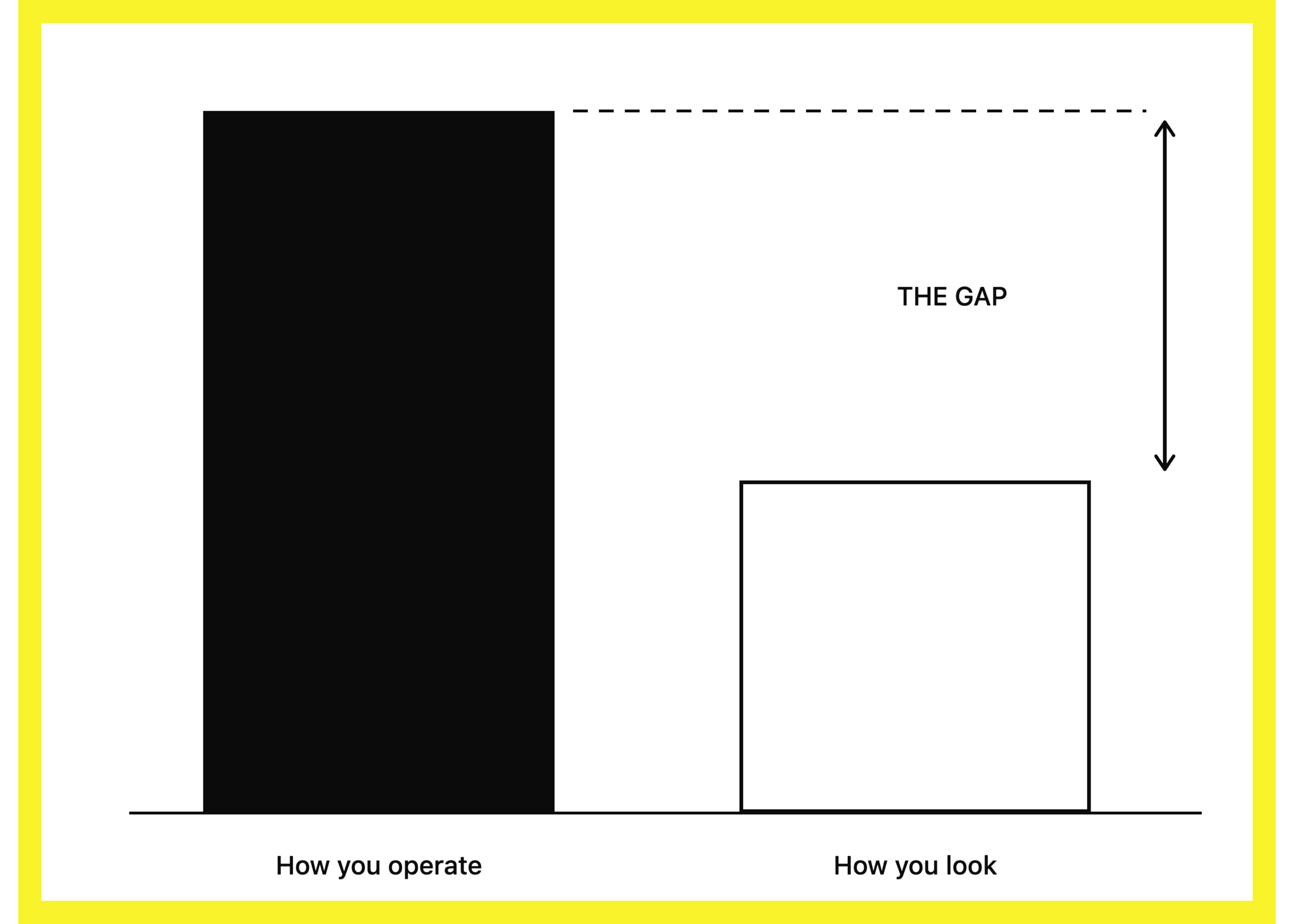
The distance between how an organization operates and how it is perceived in the market.
Three Forces Reshaping Business Expectations
Modernization is being accelerated by three fundamental shifts in how people evaluate organizations.
1. Speed.
Buyers, donors, and prospective employees are researching organizations before making contact. They expect to understand what an organization offers almost immediately. Unclear messaging creates friction, and friction creates opportunities for competitors.
2. Comparison.
Organizations are no longer judged solely against direct competitors. People compare every interaction with the best experiences they have encountered, regardless of industry. Expectations around clarity, convenience, responsiveness, and professionalism continue to evolve.
3. Digital trust.
Referrals and word of mouth remain valuable, but recommendations are increasingly validated online. Websites, reviews, social media, and AI-powered search influence perceptions long before a conversation begins.
Together, these shifts reinforce an important principle: delivering exceptional value is no longer enough. Organizations must also make that value visible, credible, and relevant.
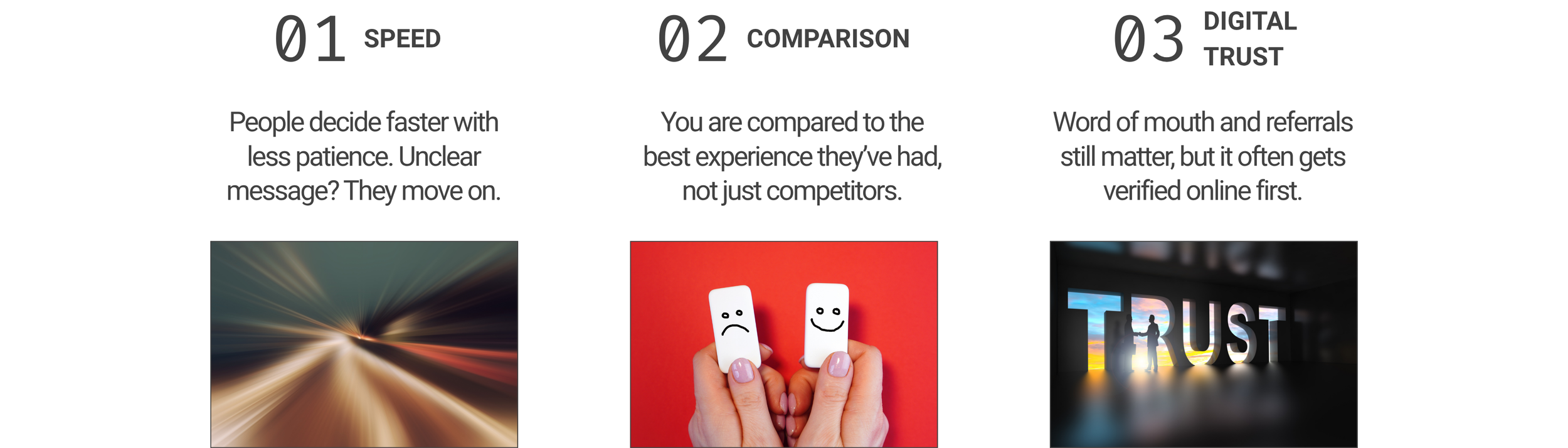
Three forces reshaping business expectations.
Five Practical Moves to Modernize in 90 Days
Modernization doesn't have to begin with a major investment or an organizational overhaul. Meaningful progress can start with five deliberate actions.
1. Run the 10-second test.
Show your homepage to three people unfamiliar with your organization. Give them ten seconds to review it, then ask what you do, who you serve, and why someone should choose you. If they cannot answer, prioritize clarity before design.
2. Ask your best customers why.
Speak with five customers, clients, or donors. Ask why they chose you, what almost stopped them, and how they would describe you to someone else. Their responses can reveal the value your organization delivers but may not be communicating.
3. Audit your touchpoints.
Review every place people encounter your brand, from your website and social channels to proposals, email signatures, and customer communications. Identify inconsistencies, outdated information, and opportunities to strengthen the experience.
4. Write one core message.
Develop two or three sentences explaining who you help, what you help them achieve, and what makes you different. Integrate that message across your organization so employees can consistently communicate your value.
5. Build a simple rhythm.
Choose one communication channel, establish a manageable publishing schedule, and track one meaningful performance indicator. Consistency creates momentum, and momentum creates opportunities for growth.
These five moves are intentionally accessible. They can be implemented by organizations of different sizes, sectors, and budgets.
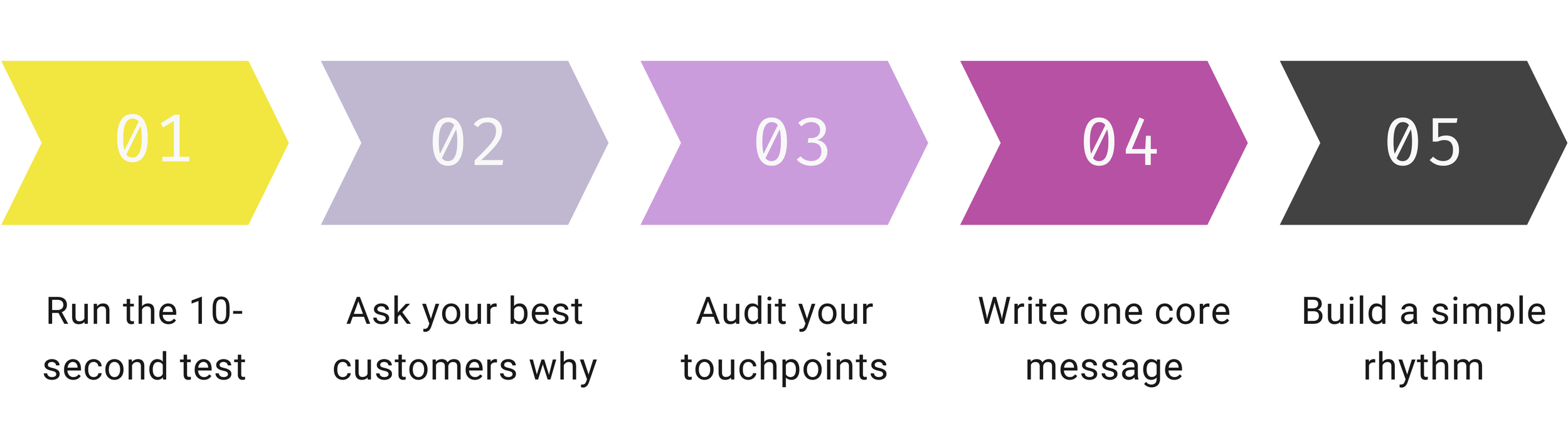
Five practical moves to modernize in 90 days.
Where Does AI Fit?
Artificial intelligence is becoming an increasingly important part of modernization, but technology alone does not create meaningful transformation.
Organizations need to establish clear guidelines for responsible AI use, identify practical applications, and develop the internal capabilities to integrate these tools effectively.
At Blox, we view AI as an extension of human capability rather than a replacement for human thinking. Its greatest potential lies in helping people work more intelligently, creatively, and efficiently.
However, without a clear strategy, AI can just as easily accelerate inconsistency as improve performance. The foundation must come first.
Building Long-Term Brand Equity
Modernization is not about abandoning what made an organization successful. It's about understanding which strengths to preserve, which capabilities to evolve, and how to bring them together to create lasting value.
At Blox Communications, our creative-technical approach combines research, brand strategy, content, communication, marketing execution, growth-ready assets, and AI enablement. Our five-phase service model - Discover, Define, Design, Deliver, and Assets - provides a structured pathway for organizations to evolve with purpose.
Ultimately, modernization is an ongoing discipline rather than a one-time project. It requires organizations to continually evaluate the relationship between their internal capabilities, external perceptions, and changing market expectations.
The goal isn't simply to look modern. It's to remain relevant, resonate with the people who matter, and build the trust that sustains long-term growth.
And the best place to begin? Identify one gap, make one meaningful improvement, and build from there.
I hope you enjoyed this post.
Thanks for reading!
Blox
Blox Communications is a creative-technical consultancy helping legacy businesses, growth-stage companies, and non-profit organizations modernize, strengthen their brands, and build long-term value.
